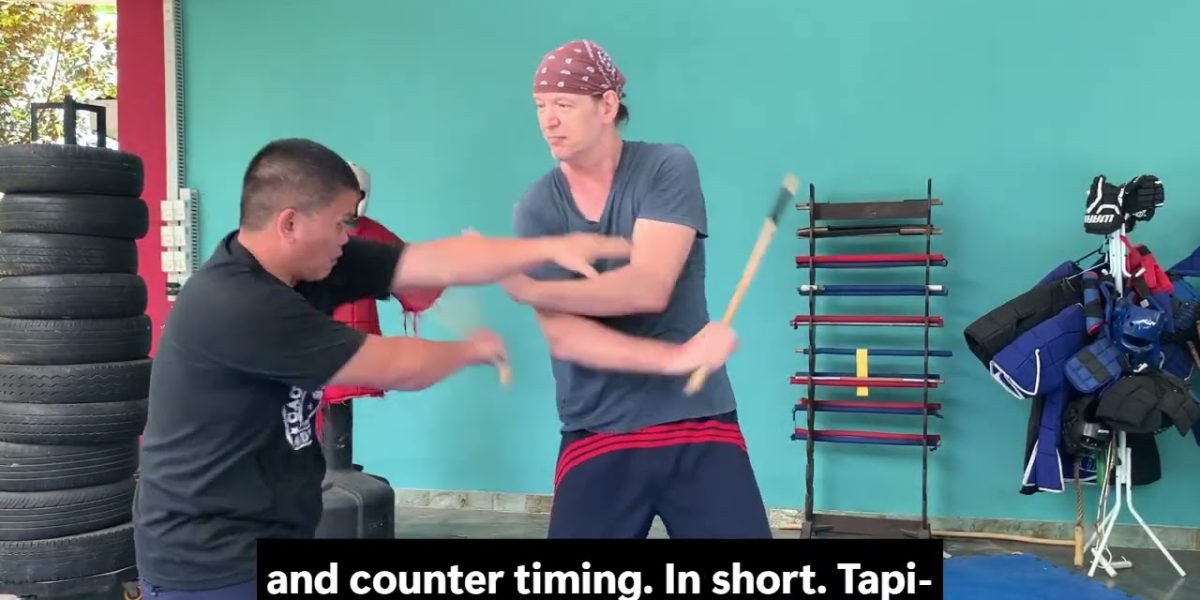
Tapi -Tapion or in short Tapi-tapi means?
Tapi means parry, and Tapion means block. When combined, they form Tapi Tapi, which is the shorthand expression for Block and Parry.
Every Eskrima system or style has its own interpretation of Tapi Tapi. The expression may be the same, but the application, timing, and philosophy behind it often differ from lineage to lineage.
In the CCDP system, Tapi Tapi is understood as a method to educate both hands—the left hand and the right hand—so that each develops its own independent mind.
This means:
• Each hand learns to read, intercept, and respond without relying on the other.
• The practitioner develops ambidextrous awareness, allowing both hands to perform parries, blocks, traps, and counters with equal intelligence.
• Tapi Tapi becomes a training method that builds reflex, sensitivity, and decision making in close quarter engagements.
By training both hands to think and act independently, the practitioner gains:
• Faster reaction time
• Better control in tight spaces
• Improved weapon retention and redirection
• Balanced coordination between offensive and defensive actions
• A deeper understanding of flow, timing, and counter timing
In short, Tapi Tapi in CCDP is not just a technique—it is a mindset and a training philosophy that sharpens the practitioner’s ability to manage chaos with both hands working intelligently.
In CCDP, our version of Tapi Tapi is intentionally different from other Eskrima systems. While many styles use Tapi Tapi simply as block and parry drills, CCDP treats it as a foundational development method that prepares the student for higher level Eskrima skills.
1. Preparing the Student for Palutsanay sa Olisi
CCDP Tapi Tapi is designed to build the reflexes, timing, and hand intelligence needed for Palutsanay sa Olisi—the advanced skill of passing through the guard and creating clean entries (lusot) in close quarter combat.
2. Developing an Eskrimador Who Can Adapt to Any Style
CCDP Tapi Tapi also trains the student to become a versatile and adaptive eskrimador. Because every Eskrima system has its own rhythm, timing, and interpretation of Tapi Tapi, CCDP prepares the practitioner to:
• Adjust to different fighting ranges
• Respond to various angles and striking patterns
• Adapt to different schools’ timing and flow
• Counter multiple styles of offense and defense
• Maintain composure and intelligence in chaotic exchanges
In short, CCDP Tapi Tapi builds a fighter who is not locked into one style, but can blend, adjust, and respond to any Eskrima system he encounters.
3. The Core Philosophy Behind CCDP Tapi Tapi
CCDP emphasizes:
• Independent intelligence of both hands
• Balanced offensive and defensive reflexes
• Close quarter sensitivity and awareness
• Fluid transitions from defense to offense
• Preparation for advanced Eskrido and weapon applications
This makes CCDP Tapi Tapi a complete developmental tool, not just a drill.